
ENGINEERING
Licence Plate Recognition Parking Systems
Cameras and lighting chosen for the lane's light, gradient and speed; whitelisted vehicles open the barrier automatically, visitors are pre-registered, captures are archived as evidence, and existing barriers can be retained and retrofitted.
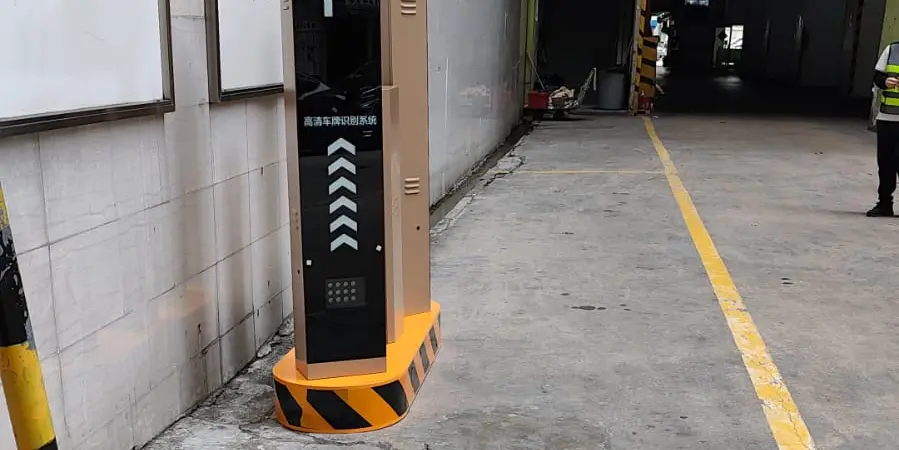
What ANPR solves is identifying which car is which. The system reads the plate with a confidence value, checks it against the whitelist, visitor list or blacklist, and decides whether to open or hold the barrier — while archiving the plate image and a front-of-vehicle overview for later enquiries or dispute handling. It is an access management tool, not an extension of any police database, and we never present it that way to clients.
Hong Kong plates come in more than one format. Two-line plates, custom plates, motorcycle plates, trailer plates — plus dirt, plastic covers and reflective edges — all reduce recognition rates. The system can handle Hong Kong, Mainland China and Macau plates simultaneously, prioritising local plates. But for cross-border or dual-plated vehicles, we still recommend bringing a real vehicle to the lane for a live test, rather than judging by the specification sheet alone.
Lane conditions matter more than camera resolution. East- and west-facing entrances suffer backlighting, rainy nights bring ground reflections, downhill approaches and sharp bends tilt the plate, and fast or closely spaced vehicles can put two plates in a single frame. During the survey we record sun direction, lane length, gradient and queuing space before deciding camera height, focal length, lighting and trigger position — adding ground loops or radar where needed rather than relying on image triggering alone.
List management falls into three categories: residents and monthly parkers open the barrier automatically, with one bay able to register several plates though usually only one vehicle allowed inside at a time; visitors are pre-registered by property staff or residents and expire automatically; blacklist hits only notify the guard on duty — they do not mean a police report, and nothing is reported to any authority automatically. All entry and exit records can be searched by plate, date, lane and time period.
Existing barriers are not necessarily waste. Where the arm structure, motor and safety devices are sound, they can be retained with recognition cameras, displays and control modules added, at lower cost and shorter duration than full replacement. But where control interfaces are worn out, or there is no anti-collision or anti-drop protection, we recommend replacement — one barrier striking a car usually costs more in compensation and repairs than the price difference of a new barrier.
Narrow lanes are the most common challenge in Hong Kong's older car parks. Single-lane two-way flow, intelligent traffic light linkage, and time-shared entry and exit are all workable approaches. The design must also account for fire service access, emergency vehicle entry and power-failure release — not just look good on a drawing.
Deliverables include a lane test report (recognition performance across different times and weather), list and tariff rule configuration, display text, a fallback release procedure, and on-site training for security staff. When the system misbehaves, the frontline must know how to release a vehicle within a minute — not wait for someone to come and fix it.
All systems are installed and maintained in-house by our group engineering team, with optional remote monitoring via our 24-hour control centre. Call our 24-hour customer service hotline or submit an enquiry throughContact Us— we will survey the site first, then propose a solution.
Other Engineering Systems
Smart Door Access Systems
We design card, mobile, QR code and facial access around each door, its traffic flow and its permissions — with fire alarm integration and offline operation built in.
Learn more →
AI-CCTV Systems
Cameras chosen by pixel density, storage sized by retention period; AI alerts for line crossing, loitering and crowds — with privacy masking and open-protocol integration.
Learn more →
Video Intercom and Visitor Management
IP intercom with mobile answering and QR code visitor registration; multi-block networking with power-failure backup, while elderly residents can still press the bell to talk.
Learn more →
Intruder Alarm and Electronic Guard Tour Systems
Intrusion detection, emergency buttons, guard tour points and alarm monitoring — with the emphasis on reducing false alarms; patrol records carry time and location, audit-ready.
Learn more →
Solar Power and Energy Storage
Rooftop and car park canopy photovoltaic systems with energy storage, leveraging the government's Feed-in Tariff scheme to cut common-area electricity costs.
Learn more →
Structured Cabling and ELV Works
Fibre, copper, cabinets, Wi-Fi and power planning — with test reports, labelling and fire stopping. ELV cabling is the foundation of the entire system.
Learn more →