
ENGINEERING
AI-CCTV Systems
Cameras chosen by pixel density, storage sized by retention period; AI alerts for line crossing, loitering and crowds — with privacy masking and open-protocol integration.
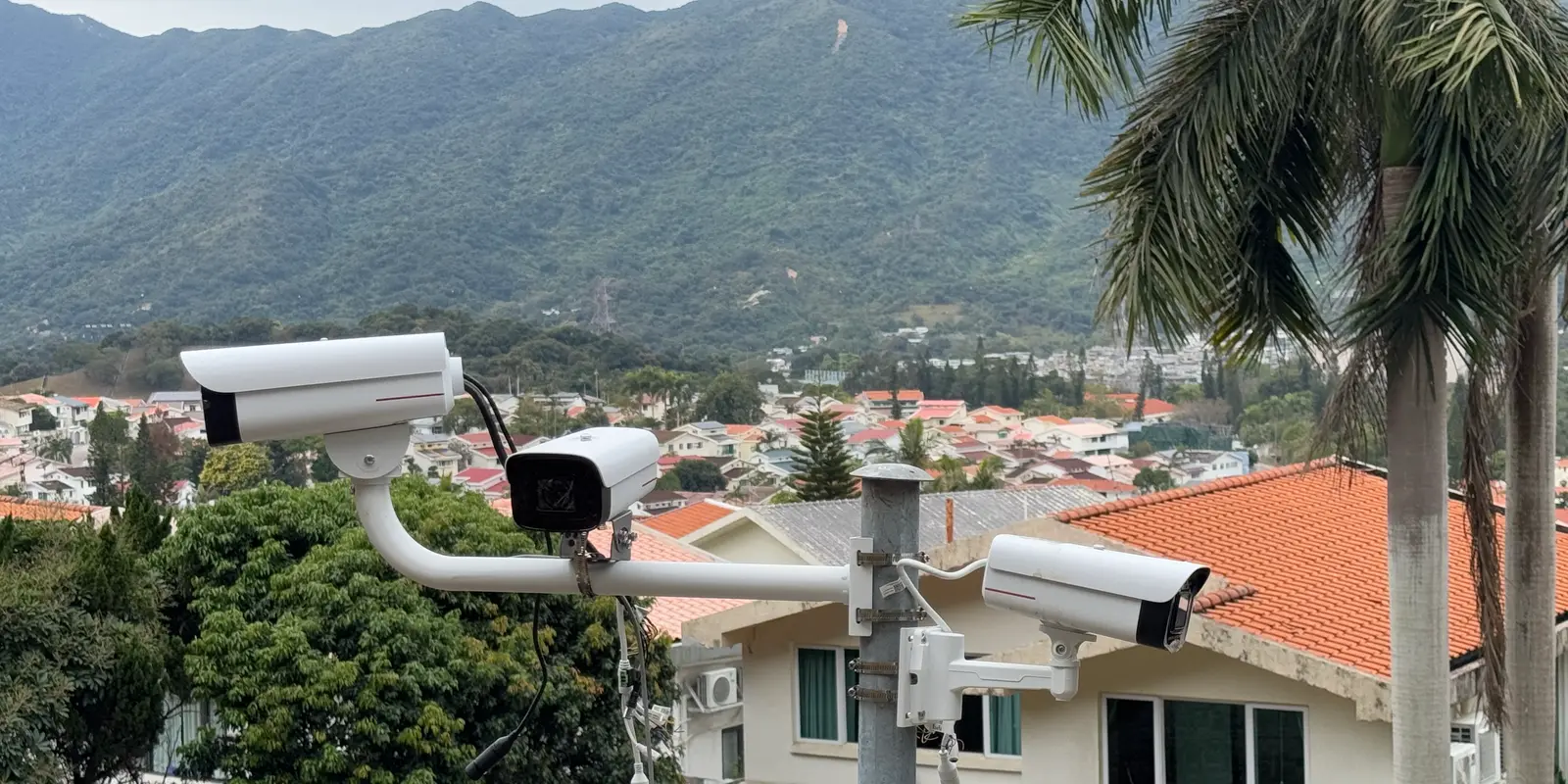
The practical value of CCTV depends on seeing clearly, not on installing many cameras. We set pixel density by what each position must identify: spotting that someone walked past, and reading a face or a plate, differ by several times in specification. Every quotation itemises each camera's purpose and coverage — we do not gloss over it with phrases like thirty cameras site-wide.
Storage is sized backwards from the retention period. We first confirm whether the client needs 30, 60 or 90 days, then calculate from bitrate, camera count and recording mode, with twenty per cent headroom. Many sites were under-provisioned at the outset and can only retain seven days — and the footage is missing exactly when an incident happens. We make this explicit at the design stage.
AI analytics are not a panacea, and should not replace human monitoring. The genuinely useful functions fall into a few categories: fence or restricted-area crossing, excessive loitering in specific zones, crowd gathering, illegal parking, abandoned objects, and cameras blocked or moved. Each needs its sensitivity and time thresholds tuned on site — otherwise you get hundreds of false alerts a day and the frontline simply switches notifications off.
Privacy must be addressed from the start. Windows of residential units, neighbouring buildings' private space, and changing room and washroom entrances should all have masking zones. Audio recording is regulated by the Personal Data (Privacy) Ordinance in Hong Kong; unless there is a clear need and proper notification, we advise against enabling it. Camera positions and angles should be limited to the stated purpose, and not incidentally cover more than necessary.
The system can integrate with access control, parking and intercom: an intercom call pops up the relevant camera view; a recognised visitor plate alerts the management office in advance; a restricted-area alarm triggers recording and a push to the duty phone. These integrations should be built on open protocols (ONVIF, RTSP, API) rather than locking the client into one closed platform.
Remote viewing is convenient, but permissions must be tight. Management office supervisors, night-shift supervisors and engineers should have different levels; departing staff's accounts are deactivated immediately; outsourced contractors see only designated cameras. We configure all of this at handover and leave behind an account inventory.
Legacy analogue systems can be partially retained: encoders can bring existing cameras onto the new platform, so a full rip-and-replace is not always necessary. But image quality and low-light performance have real limits — we will say honestly which positions are worth replacing and which can serve another two or three years.
All systems are installed and maintained in-house by our group engineering team, with optional remote monitoring via our 24-hour control centre. Call our 24-hour customer service hotline or submit an enquiry throughContact Us— we will survey the site first, then propose a solution.
Other Engineering Systems
Smart Door Access Systems
We design card, mobile, QR code and facial access around each door, its traffic flow and its permissions — with fire alarm integration and offline operation built in.
Learn more →
Licence Plate Recognition Parking Systems
Cameras and lighting chosen for the lane's light, gradient and speed; whitelisted vehicles open the barrier automatically, visitors are pre-registered, captures are archived as evidence, and existing barriers can be retained and retrofitted.
Learn more →
Video Intercom and Visitor Management
IP intercom with mobile answering and QR code visitor registration; multi-block networking with power-failure backup, while elderly residents can still press the bell to talk.
Learn more →
Intruder Alarm and Electronic Guard Tour Systems
Intrusion detection, emergency buttons, guard tour points and alarm monitoring — with the emphasis on reducing false alarms; patrol records carry time and location, audit-ready.
Learn more →
Solar Power and Energy Storage
Rooftop and car park canopy photovoltaic systems with energy storage, leveraging the government's Feed-in Tariff scheme to cut common-area electricity costs.
Learn more →
Structured Cabling and ELV Works
Fibre, copper, cabinets, Wi-Fi and power planning — with test reports, labelling and fire stopping. ELV cabling is the foundation of the entire system.
Learn more →