
ENGINEERING
Structured Cabling and ELV Works
Fibre, copper, cabinets, Wi-Fi and power planning — with test reports, labelling and fire stopping. ELV cabling is the foundation of the entire system.
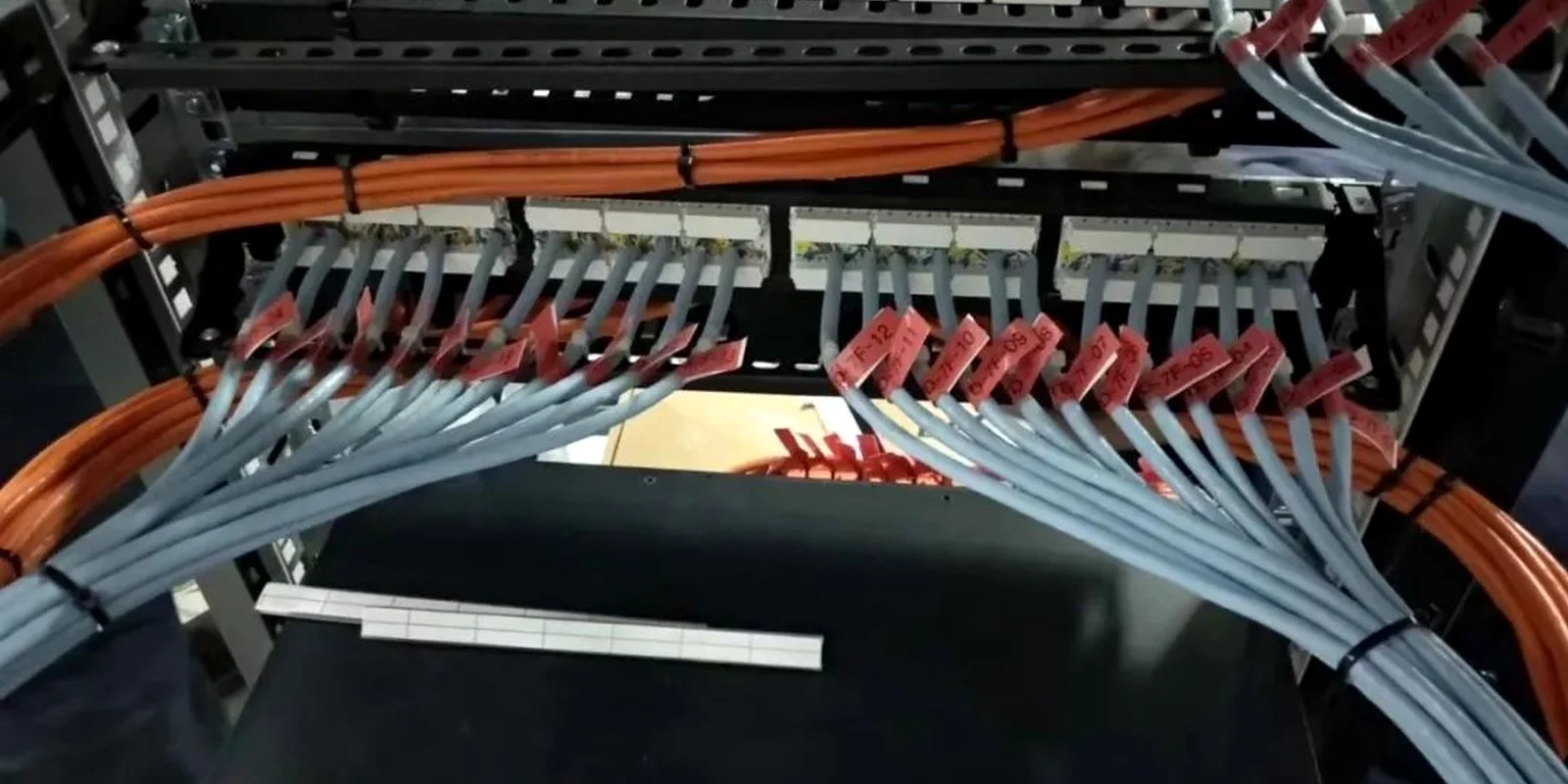
ELV cabling is the foundation of the whole system. However sharp the cameras or clever the access control, if the cabling is untested, unlabelled and without fire stopping, nobody will dare touch it two years later. We treat cabling as a standalone engineering discipline, not a free add-on to an installation.
Transmission media are chosen by distance and purpose: single-mode fibre for backbones, with multimode fibre workable between floors and plant rooms; Cat6 or Cat6A copper for terminal devices, depending on whether 2.5G / 10G throughput and PoE power are required. Car parks, rooftops and external walls face lightning, moisture and UV — there we specify fibre or surge protection as needed, rather than letting one network cable struggle on.
Power must be calculated in advance. The PoE budget is not camera count multiplied by maximum draw — startup surges, cable losses and future expansion all need headroom, and distant points may need PoE extenders or local power. The plant room end requires a UPS covering at least the control host, network switches and access controllers, so the system shuts down in an orderly fashion during an outage instead of losing data to a sudden cut.
Workmanship details determine future maintenance costs. Trunking and conduit must have adequate fill factors and bending radii to specification; penetrations through fire compartments require fire stopping; both ends of every cable carry labels matching the as-built drawings; cabinet patching is organised by zone and purpose, with space kept for expansion. None of this looks impressive in photographs, but it decides whether the next repair takes ten minutes or two hours.
Handover includes permanent link test reports for copper (length, attenuation, near-end crosstalk, return loss) and fibre attenuation tests, together with a port allocation table, cabinet layout drawings and an IP address schedule. If the client later engages another contractor, they can carry on from this documentation — no lock-in.
For Wi-Fi coverage we start with a site survey and interference scan before deciding access point count and placement. Corridors, plant rooms, car parks and podiums have very different signal demands; rather than blanketing the whole site, it is better to serve the places people actually use with proper coverage and roaming, and to keep the management network separate from the guest network.
Where a project spans multiple buildings or cross-district links, we plan backbone routes, switch stacking and VLAN segmentation together, so that access control, CCTV, intercom and office networks do not interfere with one another. Where public address or fire systems require integration, interfaces are reserved according to the relevant contractors' requirements.
All systems are installed and maintained in-house by our group engineering team, with optional remote monitoring via our 24-hour control centre. Call our 24-hour customer service hotline or submit an enquiry throughContact Us— we will survey the site first, then propose a solution.
Other Engineering Systems
Smart Door Access Systems
We design card, mobile, QR code and facial access around each door, its traffic flow and its permissions — with fire alarm integration and offline operation built in.
Learn more →
Licence Plate Recognition Parking Systems
Cameras and lighting chosen for the lane's light, gradient and speed; whitelisted vehicles open the barrier automatically, visitors are pre-registered, captures are archived as evidence, and existing barriers can be retained and retrofitted.
Learn more →
AI-CCTV Systems
Cameras chosen by pixel density, storage sized by retention period; AI alerts for line crossing, loitering and crowds — with privacy masking and open-protocol integration.
Learn more →
Video Intercom and Visitor Management
IP intercom with mobile answering and QR code visitor registration; multi-block networking with power-failure backup, while elderly residents can still press the bell to talk.
Learn more →
Intruder Alarm and Electronic Guard Tour Systems
Intrusion detection, emergency buttons, guard tour points and alarm monitoring — with the emphasis on reducing false alarms; patrol records carry time and location, audit-ready.
Learn more →
Solar Power and Energy Storage
Rooftop and car park canopy photovoltaic systems with energy storage, leveraging the government's Feed-in Tariff scheme to cut common-area electricity costs.
Learn more →