
CASE STUDY
Industrial Building: Single-Lane Two-Way Traffic with Octopus Payment
The original barriers were retained, with ANPR, LED displays and traffic lights added to resolve head-on conflicts on a narrow lane.
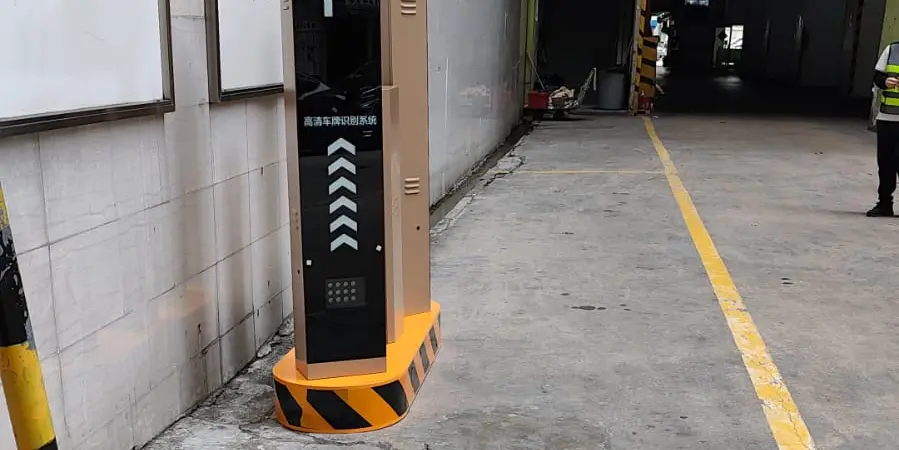
Industrial building in Kwun Tong (client name withheld under confidentiality arrangement)
Background
The building has a single lane under twenty metres long that must serve both entry and exit. Traffic was previously coordinated by guards by eye, and head-on standoffs were common at busy times; reversing trucks frequently struck the barrier arms. The owner did not want major structural changes and preferred an equipment-based solution.
Design
The existing barrier arms and motors were retained. We added an ANPR camera, an LED display and a pair of traffic lights, with inductive ground loops determining vehicle position. Once an entering vehicle is identified, the exit direction shows red; when the vehicle tail clears the loop, the system returns to two-way standby. Hourly parkers pay by Octopus before exiting, while monthly parkers pass directly.
Challenges
The lane is short and steeply inclined, so plates distort easily in the frame, and strong side sunlight hits the lane during the day. We mounted the camera higher ahead of the barrier, fitted a sun hood and supplementary lighting, and used two-stage triggering (loop plus image) to avoid misreads. Commissioning was carried out with real trucks, vans and private cars, each tested repeatedly.
Result
Head-on conflicts dropped substantially, as did the number of times barrier arms were struck. Guards no longer need to stand in the middle of the lane for long periods and can cover other posts. The system retains a manual release button, and the barrier arm can be raised by hand during power failure. Deliverables included lane test records, a tariff rules table and a fallback release procedure.
Other Case Studies
Private Estate: Integrated Entrance Access and Car Park ANPR across Three Blocks
Residents pass with mobile phones or cards, the car park opens automatically via licence plate recognition, visitors use one-time QR codes, and works were delivered in three phases without closing main access routes.
Read case study →
Grade A Office: Lobby Speed Gates, Self-Service Visitor Registration and Lift Control
Staff pass the gates with cards or phones, visitors self-register and receive QR codes, and lifts only stop at authorised floors.
Read case study →
Secondary School: Classroom Card Access, Special Room Permissions and Parent Notifications
Staff open classrooms with cards, special rooms are authorised by subject and timetable, and parents can be notified when students enter or leave the campus.
Read case study →
Retail Chain: Unified Access Control and Attendance across Twelve Stores
Head office issues and revokes credentials centrally, store managers view attendance for their own store only, and departing staff lose access the same day.
Read case study →
Server Room and Data Centre: Two-Factor Access and Environmental Monitoring
Card plus finger-vein two-factor entry, interlocked double doors, full entry logging, and water leak and temperature alarms.
Read case study →